Step 01
Choose a small day
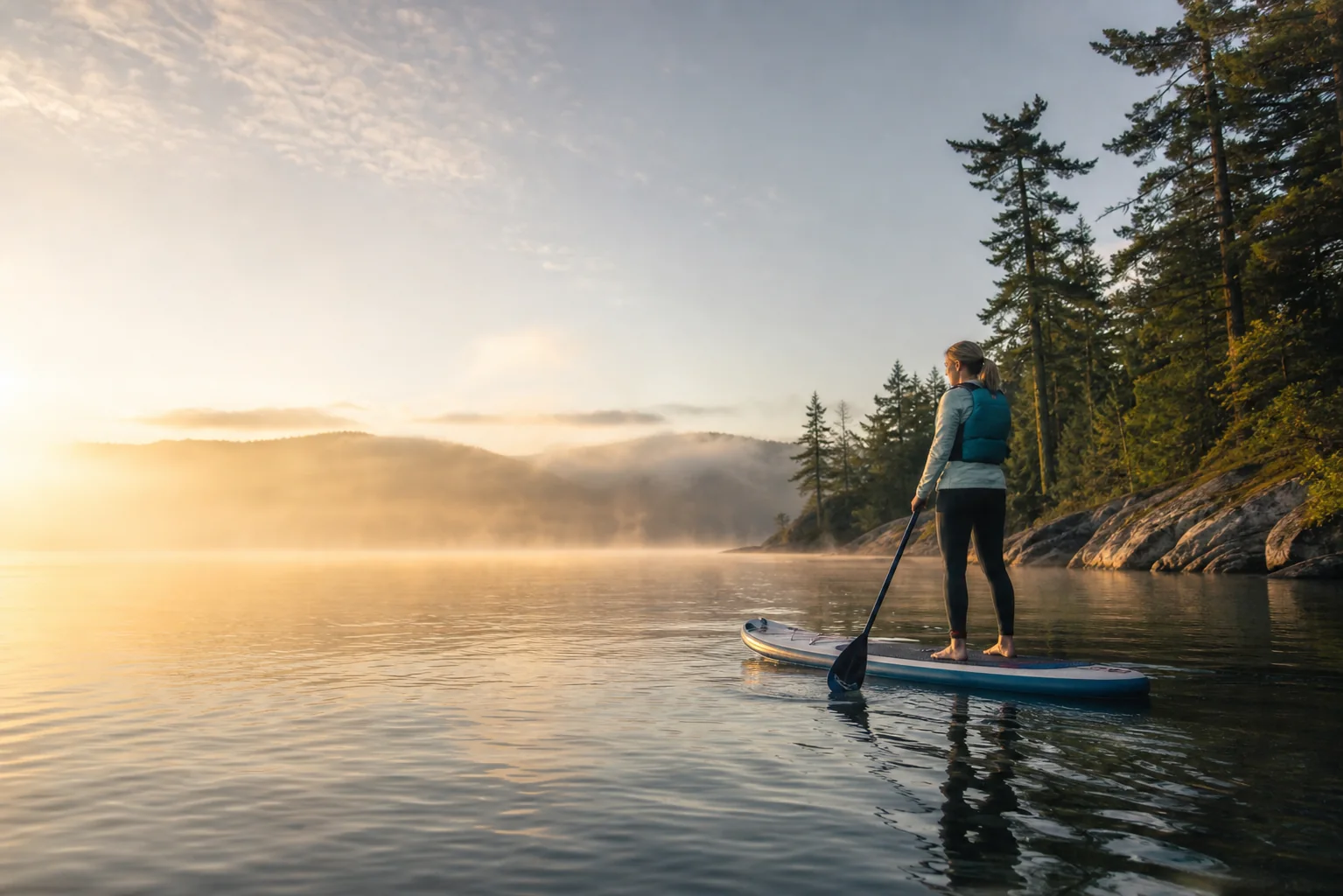
Pick sheltered, obstruction-free water with an easy launch and low traffic. Check wind direction, forecast, water temperature, tide or flow, access rules and daylight. Avoid offshore wind and any condition you cannot confidently explain.
Make the first route a shoreline loop rather than a crossing. Go with a capable partner or book a lesson, tell someone where you are going and when you will return, and carry a means of calling for help on your person in a waterproof pouch.
A good first objective
Move away from the launch on your knees, stand, make controlled strokes on both sides, stop, turn back, practise a remount and land where you began.
Step 02
Build one coherent equipment system
Board & paddle
Use the exact board's recommended paddler-and-gear range and pressure. Fit the fin and set an adjustable paddle to a comfortable starting length.
PFD & clothing
Wear correctly fitted flotation suited to local rules and dress for the water temperature and a possible full immersion.
Leash & communication
Match the leash to the environment and keep a charged calling device attached to you, not only to the board.
In the United States, the Coast Guard says a SUP used beyond the narrow limits of a swimming, surfing or bathing area is a vessel and must carry a life jacket. Treat that federal carriage rule as a legal minimum, verify state and local rules, and wear the fitted PFD for actual protection.
Step 03
Launch on the knees
- 01Protect the fin.
Walk the board into water deep enough for the fin and a clear fall, while checking for submerged hazards.
- 02Find the center.
Place the paddle across the deck and climb onto your knees around the carry handle.
- 03Move before standing.
Paddle clear of the launch, turn the board and confirm the wind is behaving as expected.
- 04Bring feet to the knee marks.
Keep hands low, place one foot then the other, look ahead and rise with soft knees.
If the board feels busy, kneel again. Returning to the stable position is good judgment and part of the skill.
Step 04
Stand where the board was designed to carry you
Begin with feet roughly hip-width apart around the carry handle, toes forward, chest tall and knees relaxed. Look toward the route and let the lower body absorb movement. Avoid stepping toward the tail or nose until a centered stance feels automatic.
- Relax the grip.Hold the paddle securely without squeezing; tension travels quickly into shoulders and balance.
- Keep the blade available.A lightly planted paddle can add support while you reset.
- Scan beyond the board.Looking up improves awareness of wind, traffic, shoreline and hazards—not just balance.
Step 05
Go, stop and turn before going farther
For the forward stroke, reach comfortably, place the blade fully beside the rail, connect through gentle torso rotation and release near your feet. Switch sides when the heading begins to drift. A more vertical shaft and clean catch often improve tracking.
To stop, place the blade gently behind you and resist the board's movement. To turn, make a wide forward sweep from nose toward tail; repeat on the other side until both directions feel familiar. A reverse stroke helps slow, back up or tighten a turn.
Control is being able to choose where the board stops—not simply where it goes.
Step 06
Rehearse the recovery, then end early
In controlled water, fall clear of the board and paddle. Surface, orient and return to the board's center. Bring your legs toward the surface, kick and slide your chest onto the deck, then roll aboard and settle on your knees. Retrieve the paddle without putting yourself between the board and a hazard.
Cold, wind and fatigue make remounting harder. Practise close to shore, in clothing suitable for immersion, with a partner or instructor watching. A leash helps retain the board only when it is the correct type for that environment; moving water requires specific entrapment awareness and quick-release practice.
Land while the session still feels easy. Rinse and dry the equipment, note the paddle setting and one skill to repeat next time. Consistency grows from small successful outings.
Primary references
Check the guidance behind the guide
Conditions, regulations, and product instructions can change. These primary resources support the safety-sensitive and technical points above; always check the latest local information before launching.
Clear answers
Frequently asked questions
01Is paddleboarding difficult for a complete beginner?
Most people can begin on calm water by kneeling, but competence takes practice. Conditions, equipment fit and instruction matter more than trying to stand immediately.
02Where is the best place to learn?
Choose sheltered, obstruction-free water with low traffic, an easy launch and a short route close to shore. Verify wind, water temperature, tide or flow and local access on the day.
03Do I need a PFD?
Wear one suited to you, the activity and local rules. In the US, Coast Guard carriage requirements apply to SUPs used beyond narrow swimming, surfing or bathing areas; state and local rules may be stricter.
04Which leash should a beginner use?
On unobstructed flat water, a suitable leg leash is common. Moving or tidal water can create entrapment risk and calls for local instruction and an appropriate reachable quick-release waist system.
05How do I get back on after falling?
Return to the center, bring the legs toward the surface, kick while sliding the chest onto the deck, then roll aboard and settle on the knees. Practise in controlled water before relying on it.
06How long should my first session be?
Long enough to complete the small skill loop while keeping energy for a fall, remount and landing. Conditions and the individual matter more than a fixed number of minutes.