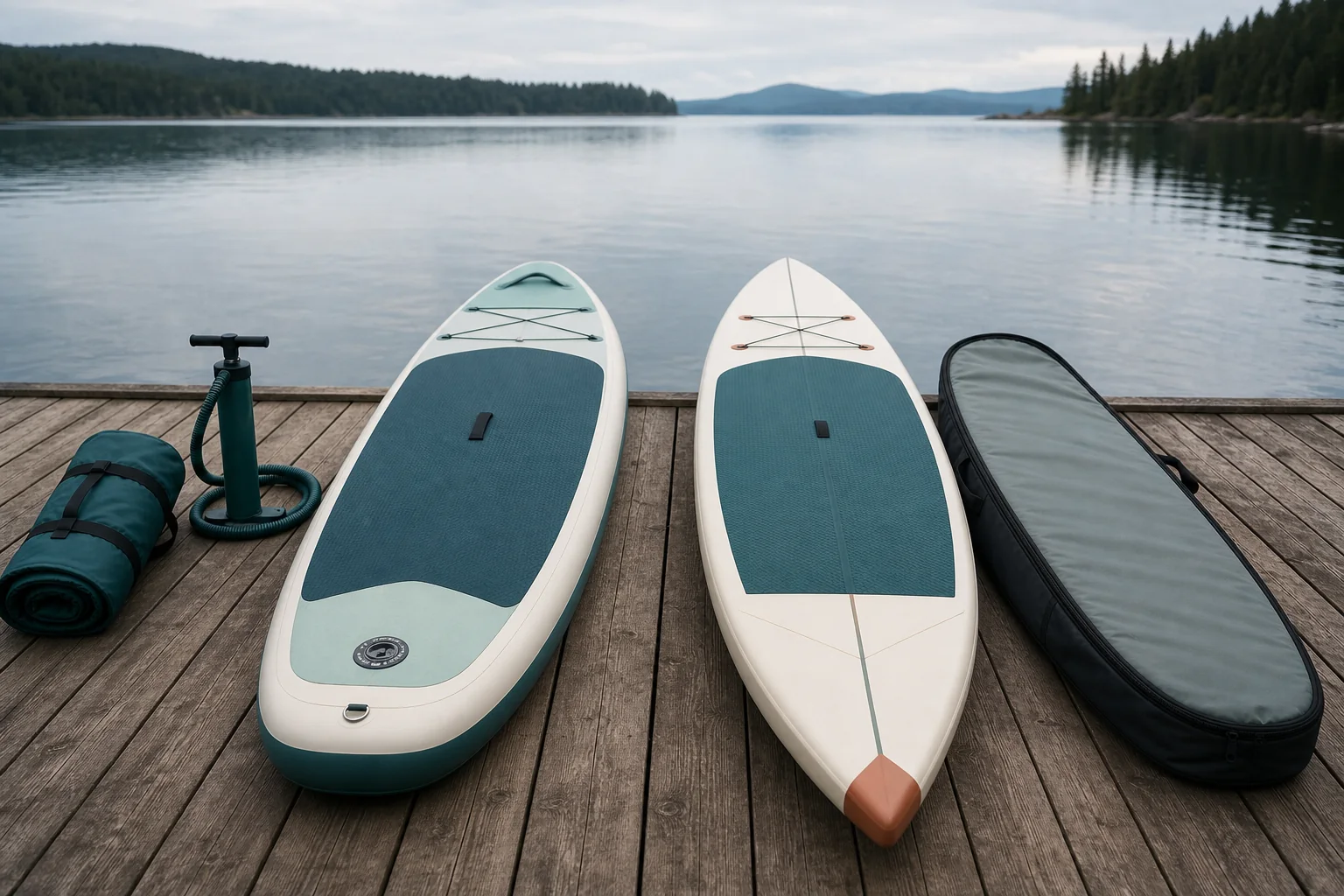
The useful split
Begin with home and transport
The board must disappear
You live without long-board storage, travel by small car, use public transport, fly, or walk a meaningful distance to water. Budget time for correct inflation, drying and packing.
Ready-to-paddle feel matters
You have padded storage and a suitable transport system, want no pumping at the launch, or prioritize crisp rail shape, low flex and specialized performance.
Then compare the exact boards by combined-load range, intended use, dimensions and construction quality. A premium inflatable can be a better recreational fit than the wrong hard board, and vice versa.
Different vulnerabilities
Tough does not mean careless
Modern inflatable boards use drop-stitch cores and coated fabrics that become rigid at the pressure specified by the maker. They tolerate many everyday bumps, but sharp edges, dragging, UV, solvents, excessive pressure and trapped moisture can damage fabric, seams and valves.
Hard boards cannot puncture and need no air pressure, but they can ding, crack, delaminate or take water through damaged skin. Rails and noses need protection during transport and storage. Some repairs are straightforward; others require a material-aware professional.
Heat changes the inflatable calculation
NRS warns that direct sun or increased elevation can raise internal pressure. Use a gauge, stay within the exact board's instructions and bleed pressure when its maker tells you to.
The weekly routine
Compact is not maintenance-free
| Moment | Inflatable | Hard board |
|---|---|---|
| At home | Fits in a bag; needs cool, dry storage and loose packing as instructed | Needs a long, padded, supported space |
| At the car | Fits inside many vehicles; bag protects from cargo | Needs a suitable rack or sufficiently large interior |
| At the launch | Pump, gauge, valve and fin setup | Unload, inspect and fit fin or vent as required |
| After water | Rinse and dry fully before long storage | Rinse, dry and inspect for dings or water entry |
Inflatable portability wins only if the complete bag, pump and accessories fit the journey. Hard-board convenience wins only if moving and storing a full-length board is genuinely easy.
On-water feel
Construction matters; shape matters more
A hard shell can hold refined rails, rocker and bottom contours with little flex, which supports precise surf, race and touring designs. A well-built inflatable at its specified pressure can feel impressively rigid for recreation and travel, but it will not reproduce every hard-board edge or hull shape.
There is no honest universal percentage by which a hard board is faster. Waterline, width, rocker, surface, stiffness, load, wind and technique all affect speed. Compare boards designed for the same use; a narrow hard race board versus a wide inflatable all-rounder is a category mismatch, not a construction test.
Complete ownership
Price the system, then choose the ritual
Compare the complete package: board, suitable paddle, PFD, environment-appropriate leash, fin, pump and gauge for an inflatable, rack and protection for a hard board, repair support, warranty and storage. A low sticker price can become poor value when the pump, fittings or construction make every launch difficult.
- Buy inflatablewhen compact transport will materially increase how often you paddle and you will rinse, dry and manage pressure.
- Buy hardwhen storage and roof transport are already solved and the board's immediate readiness or performance is worth the space.
- Rent or demowhen you have not yet learned which friction matters. Carry, load, inflate, paddle and pack each format before deciding.
Primary references
Check the guidance behind the guide
Conditions, regulations, and product instructions can change. These primary resources support the safety-sensitive and technical points above; always check the latest local information before launching.
Clear answers
Frequently asked questions
01Can an inflatable paddleboard puncture easily?
Quality boards resist ordinary use, but they are not puncture-proof. Avoid sharp objects, dragging, excessive pressure, heat and incompatible chemicals; carry the maker's repair kit when appropriate.
02Which construction is better for beginners?
Either can work. Choose a stable, correctly sized model within its recommended load range. Storage, transport, setup and the exact board shape often matter more than construction alone.
03How much faster is a hard board?
There is no universal percentage. Shape, waterline, width, rocker, stiffness, load, conditions and technique all affect speed. Compare like-for-like boards in the same discipline.
04Can a damaged hard board be repaired?
Many dings can be repaired, but materials and damage depth vary. Keep water out, stop using a compromised board and follow the manufacturer or a qualified repairer's method.
05Can I leave an inflatable board inflated?
Only under its manufacturer's instructions. Keep it away from direct sun and heat, monitor pressure, and reduce pressure for storage when the maker requires it.
06How long will either type last?
There is no reliable universal lifespan. Construction quality, UV and heat exposure, impacts, pressure, drying, storage and repair quality all influence service life.