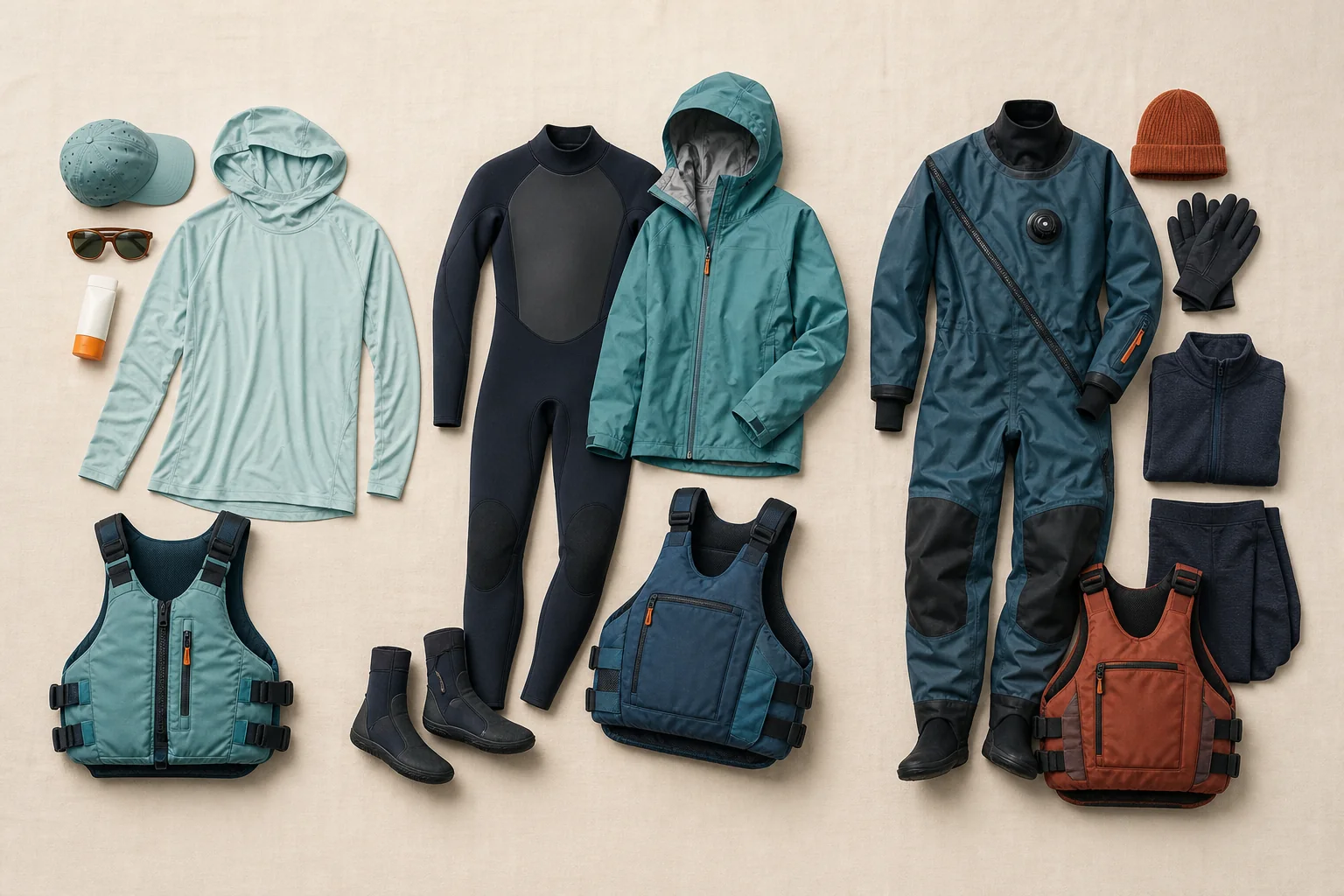
The governing principle
Plan for being in the water, not above it
The US National Weather Service advises dressing for the water temperature, not the air temperature. That matters on bright spring days, high-altitude lakes and any venue where a fast fall becomes cold shock or loss of useful movement.
No single chart can prescribe clothing from temperature alone. Consider how often you may fall, wind, trip length, distance from shore, rescue time, sun, your health and whether the kit still works when wet. If the consequence of immersion exceeds the clothing and skills you have, postpone the session.
Flotation remains essential
Thermal clothing is not a substitute for a correctly fitted PFD or buoyancy aid. A drysuit without appropriate insulation may keep water out but still leave a paddler cold.
Warm conditions
Light, quick-drying and ready for wind
When the water is genuinely warm and the route is conservative, choose swimwear or quick-drying layers that allow a full stroke. Add a UPF top, brimmed hat with secure fit, sunglasses retention and a dry insulating layer in a dry bag. Wear the PFD over the complete outfit and confirm it cannot ride up.
A warm afternoon can still become uncomfortable after a swim or when wind rises. Cotton absorbs water and dries slowly; technical synthetics or suitable wool layers manage moisture more predictably.
Use a broad-spectrum sunscreen labeled water-resistant and reapply it at the stated interval—especially after swimming or toweling.
Shoulder season
Choose an immersion system, not random layers
A wetsuit warms by limiting and retaining a thin layer of water; its thickness, coverage and fit need to match the activity and conditions. A loose or unsuitable suit may flush cold water and perform poorly. A drysuit keeps external water out but needs insulating layers beneath it and training in seals, ventilation, relief systems and care.
| System | Strength | Watch for |
|---|---|---|
| Wetsuit | Simple, robust immersion insulation when correctly fitted | Overheating on deck, restricted movement, inadequate thickness or flushing |
| Drysuit + insulation | Dry barrier with layers adaptable to demanding cold conditions | Cost, seal care, trapped air, fit, and the need for appropriate underlayers |
| Quick-dry layers | Comfortable in truly warm water and short, low-consequence routes | Little cold-water protection after immersion |
Cold water
The safest clothing choice may be no launch
Cold-water paddling raises the consequence of every small problem. Wear a PFD, use a complete immersion system appropriate to the water and expected rescue time, keep communication on your person, go with capable companions and stay close to a viable exit. Check the forecast and water temperature immediately before leaving.
Hands, feet and head need protection that preserves grip, circulation, hearing and vision. Test the complete kit—including a remount—in controlled conditions with supervision. If cold shock, swim failure or a delayed recovery is not adequately managed, choose a warmer day or professional instruction.
A thicker suit does not turn an exposed route into a beginner route.
Small details
Protect the contact points
- Feet.Use secure footwear suited to the launch surface, temperature and board grip. Loose flip-flops can become clutter; bare feet may face shells, glass, hot decks or cold.
- Hands.Choose gloves that preserve paddle control. A death grip is often a technique or fit problem, not a reason for more padding.
- Eyes and face.Use UV protection, a retained hat and shade breaks. Water reflection increases exposure.
- After the session.Carry a towel and complete dry change. Remove wet layers promptly, warm gradually and seek help for concerning cold-immersion symptoms.
Primary references
Check the guidance behind the guide
Conditions, regulations, and product instructions can change. These primary resources support the safety-sensitive and technical points above; always check the latest local information before launching.
Clear answers
Frequently asked questions
01At what water temperature do I need a wetsuit?
There is no universal cutoff. Choose protection from water temperature, immersion risk, wind, duration, distance from safety and personal factors. When uncertain, seek local professional guidance or do not launch.
02Is a drysuit always warmer than a wetsuit?
No. A drysuit is a barrier; warmth comes largely from suitable insulation underneath. Fit, seals, trapped air and training matter. A correctly fitted wetsuit works differently by insulating while wet.
03Can I wear normal gym clothing?
Quick-drying technical layers may work in genuinely warm, low-consequence conditions. Avoid relying on absorbent cotton, and remember that ordinary layers provide little cold-water protection after immersion.
04Do I need footwear?
It depends on the launch, water temperature and hazards. Secure water shoes or neoprene footwear can protect from sharp, slippery, hot or cold surfaces without becoming loose deck clutter.
05Does sunscreen stay effective in water?
Only for the water-resistance duration stated on its label. Use a broad-spectrum product as directed and reapply after swimming, toweling and the label interval.
06What spare clothing should I carry?
A complete dry change is ideal when conditions or access make a swim plausible. At minimum, keep an insulating dry layer in a properly sealed bag and a full change at the vehicle.